What Does It Actually Cost to Set Up Manufacturing in Mexico vs. the U.S.?
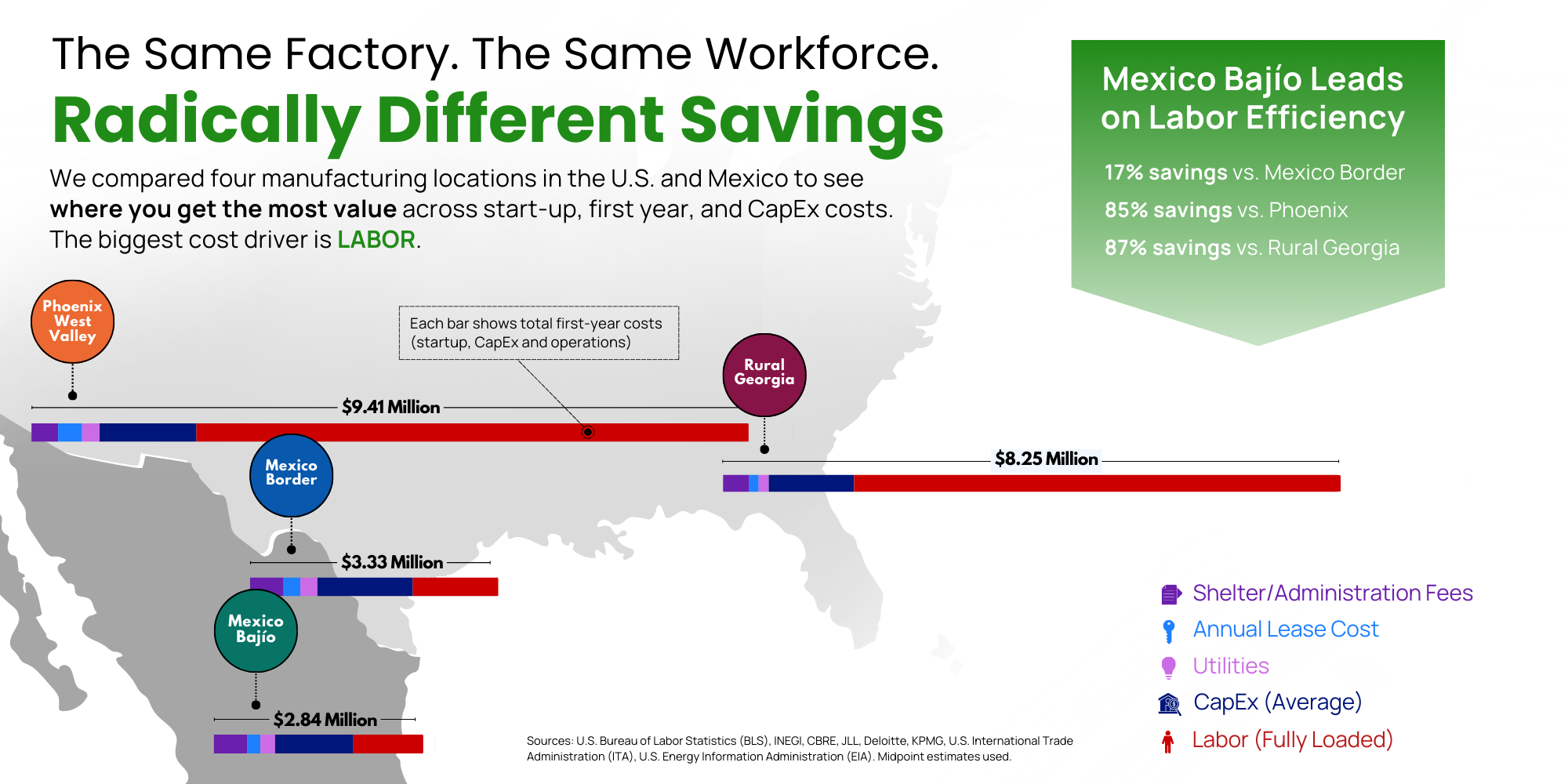
We wanted to know what a manufacturer exploring a lower-cost production location would find if they went looking on their own. So we did exactly what they would do: We pulled publicly available data from the U.S. Bureau of Labor Statistics, INEGI, CBRE, JLL, Deloitte, KPMG, and the U.S. International Trade Administration, and ran it through an AI model to build a cost comparison across four locations. The scenario was consistent across all four: a 35,000-square-foot electronics assembly operation, 100 workers, all startup and first-year costs included.
The results are useful. But running this exercise also raised a more interesting question: what does AI not know? It can aggregate published data from government agencies, real estate firms, and labor statistics bureaus. What it can't do is tell you what those numbers mean once you're actually operating, or what shifts when you factor in the experience of having set up dozens of manufacturing operations in Mexico over 20 years. We're being transparent about the methodology because the point isn't to impress you with a model. It's to show you exactly where the data stops and where real-world expertise begins.
Here's what the model found.
The Numbers Are Striking. But They Only Tell Part Of The Story.
For that baseline operation, Mexico's Bajío region (in the center of the country) comes in at $2.84 Million for year one. Phoenix comes in at $9.41 Million. Rural Georgia at $8.25 Million. The Mexico border region, which many assume is the default for nearshoring, lands at $3.33 Million, still 15% higher than the Bajío.
The biggest driver across all four locations isn't lease cost, utilities, or even CapEx. It's labor, by a wide margin. Fully loaded labor in the Bajío clocks in at $0.95 Million for the year. In Phoenix, that same workforce costs $7.25 Million. That's not a rounding error. It's the entire business case in a single line item.
What the model can't tell you is why the Bajío performs the way it does, or what happens to those numbers once you're on the ground. That's where the data ends and the nuance begins.
Why The Border Region Costs More Than Most People Expect
Mexico’s border region is cheaper than the U.S. But not by as much as most manufacturers assume, and not nearly as much as the Bajío. Wages near the border have increased sharply over the past several years. In some states, annual minimum wage increases were double those seen elsewhere in Mexico, driven by a growing number of companies competing for a smaller pool of workers in cities like Monterrey. Labor costs near the border can run as much as 50% higher than in Mexico's interior. The Bajío's distance from the border isn't a logistical weakness. For labor cost and stability, it's one of its strongest structural advantages.
Turnover Is Not Equal Across Locations
A cost model assumes a workforce. It doesn't account for whether you can keep one. Guanajuato and the surrounding Bajío states have a young, working-age population, with the largest population segment falling between 20 and 29 years old, and over 64% of residents of working age, according to Mexico's 2020 national census. More than 627,000 people in the state are already employed in industrial manufacturing, representing 24% of the total workforce.
This isn't an untested labor market. It has been shaped over decades by automotive, aerospace, and electronics investment. Companies don't arrive and build a workforce from nothing. They plug into one that already exists.
Even so, every operation has its own rhythm. Seasonal production surges, new product launches, and shifting customer demand mean workforce needs may not stay flat from one quarter to the next. In a campus-based model, that variability becomes much easier to absorb. At Entrada's campuses in Zacatecas and Celaya, workers can move between client operations based on production needs, applying existing skills across different programs rather than sitting idle during slow periods.
Over time, those workers develop capabilities across multiple manufacturing disciplines, which makes them more valuable to every operation on campus. A standalone facility can't replicate that dynamic, because it only has its own work to offer.
For companies that have seen above-average turnover, the campus environment has made a measurable difference. Telamon, an Indiana-based wire harness manufacturer operating at Entrada's Fresnillo campus, watched turnover climb to 43% annually as their Mexico operation scaled rapidly. Entrada conducted a yearlong evaluation covering HR processes, compensation benchmarking, leadership, and workplace conditions. Once the recommendations were implemented, turnover dropped by nearly 50%.
Ready To Run Your Own Numbers? Book a conversation with JP
Capex Looks Similar On Paper But Operates Very Differently In Practice
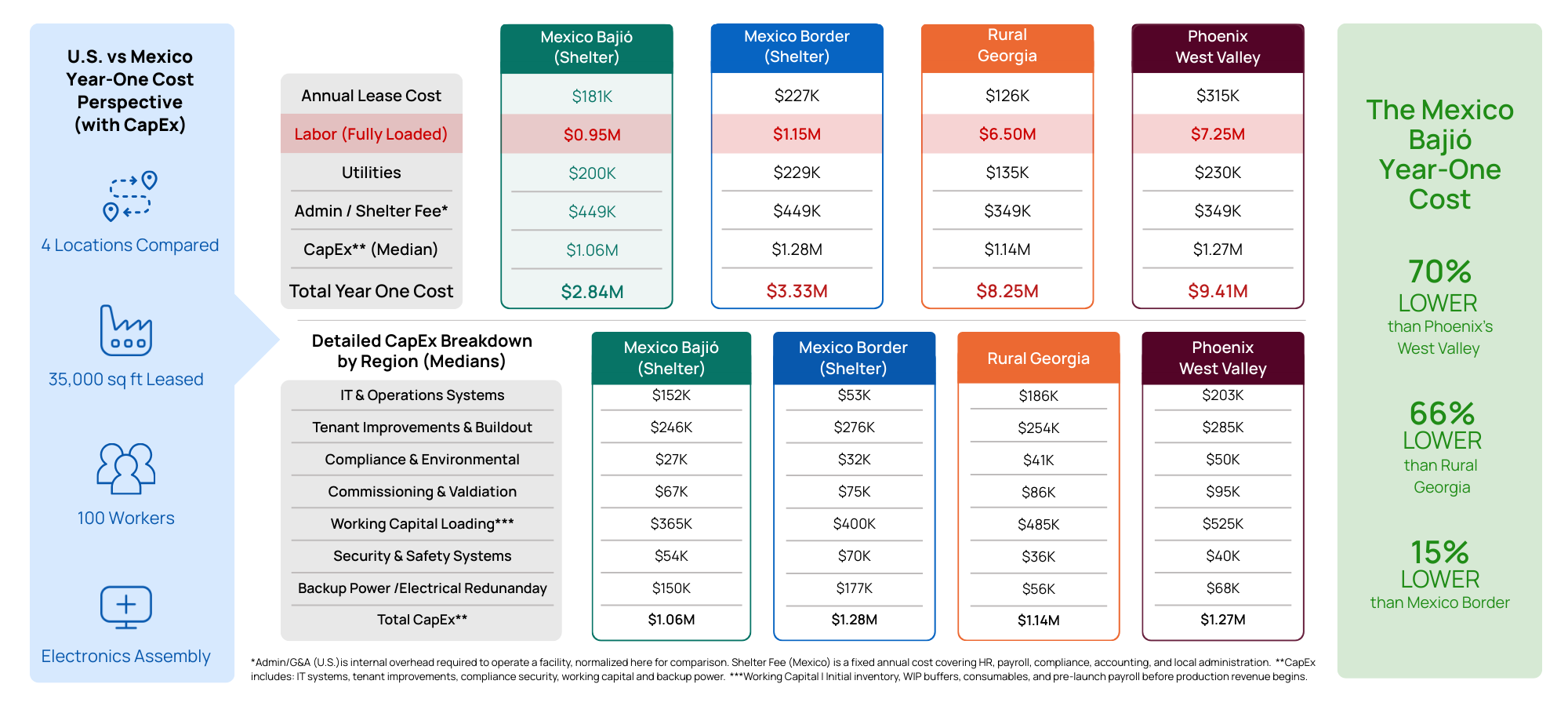
The model shows median CapEx across regions, and those numbers are closer than most people expect. What it doesn't show is that entering Mexico through a shelter provider fundamentally changes what that CapEx actually buys. Legal structure, customs compliance systems, IT infrastructure, and HR operations are already built. You're not paying to create a back office from scratch. You're joining one that already works, and that every other client on campus is already contributing to. According to Entrada's own client data, companies have saved more than $500,000 in one-time setup costs by entering Mexico through a shelter model rather than building those systems independently.
The Tariff Picture Is Better Than Most Manufacturers Realize
One of the most underestimated advantages of manufacturing in Mexico is what it does to your tariff exposure. Under USMCA, products manufactured in Mexico and shipped to the U.S. travel duty-free, provided they meet rules of origin requirements. Under the IMMEX program, manufacturers can import raw materials and components into Mexico with zero or minimal duties, as long as finished goods are exported within mandated timeframes. In practical terms, this means companies can source materials globally, transform them in Mexico, and ship finished goods into the U.S. market with near-zero tariff exposure.
Mexico's reach extends well beyond North America. With 14 free trade agreements covering 50 countries and access to approximately 60% of global GDP, a Mexico operation gives manufacturers preferential access to markets that would otherwise carry significant import duties. Getting those benefits, though, requires ongoing compliance with rules of origin, documentation standards, and program-specific reporting obligations. The Mexican government tracks tariff declarations, exemptions, and VAT refunds across three separate reporting entities. Companies doing this on their own need a dedicated team and years of track record to do it well.
Entrada manages all of it for clients, with a team of over 20 trade and compliance specialists. The company holds AAA VAT certification, which allows qualifying clients to access VAT exemption immediately rather than waiting three months or more for refunds. Entrada is also among the top 10% of IMMEX license-holders in Mexico with OEA certification which accelerates customs clearance and provides fast-track access into the U.S.
The Cost Of Not Producing
The comparison on this page captures year-one costs. It doesn't capture the cost of the months you're not producing while you're still setting up. Every week between a go-decision and first shipment is a week your new operation isn't generating revenue. That gap, whatever it amounts to for your volume and margins, is a real number that doesn't appear in any location cost model.
Entrada can get a new operation running in as little as 12 weeks. The faster the ramp-up, the sooner the savings in the comparison above start working in your favor.
What This Means Beyond Electronics
This comparison was modeled for electronics assembly, but the underlying cost drivers hold across industries. Whether you manufacture wire harnesses, automotive components, medical devices, lighting, white goods, or heavy machinery, the labor differential is consistent, the USMCA trade benefits apply the same way, and the compliance requirements don't change by sector.
What does change is how all of that interacts with your specific product, your bill of materials, and your workforce profile. A model built from public data gives you a directional answer. Getting a precise answer requires running the numbers against your actual operation.
Not Sure Where You Stand?
Before booking a conversation, it's worth knowing whether Mexico is the right fit for your business at all. Entrada's Mexico Manufacturing Readiness Calculator takes less than two minutes and gives you a clear readiness result with tailored next steps.
Ready To Run Your Own Numbers?
JP McDaris, Entrada Group's Director of Business Development, works directly with manufacturers to build location cost models using your actual inputs, not industry medians. If the Bajío numbers look compelling at a glance, the picture sharpens considerably when your own data is behind it.
Download resource